

Info Point
B
O
R
G
O
D
I
C
E
S
I
Loading

- info@cesiportadellumbria.it
- Cesi, 05100 Terni (TR), Umbria, Italia
The history of Cesi is closely linked to the birth and development of the Terre Arnolfe, a fortified territory that included many villages and which had Cesi as its main centre
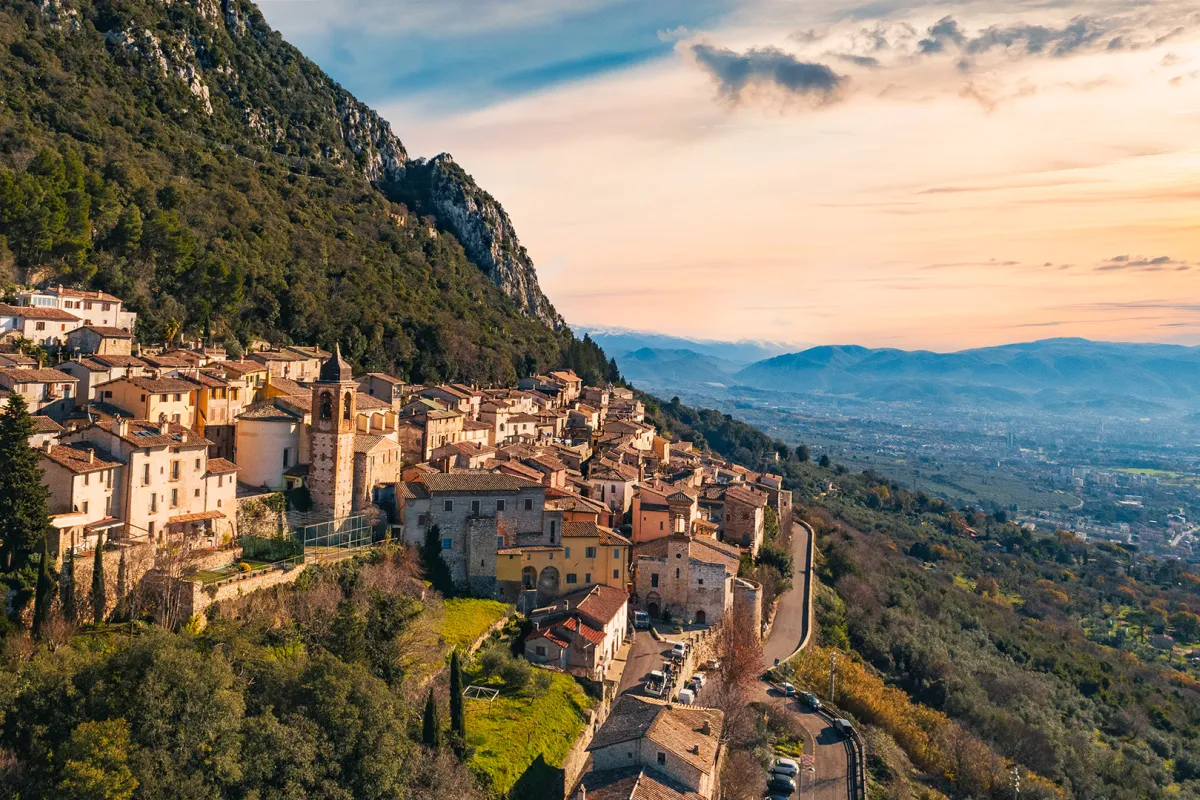
Its strategic geographical location, rich wildlife, and the presence of caves useful for defense and shelter made this place a highly important settlement for the Italic peoples of southern Umbria.
The ancient Umbrians, among the oldest peoples of Italy, left numerous traces of their presence on this mountain, from necropolises to cyclopean walls and the two temples on Monte Torre Maggiore. The archaeological finds, now displayed at the Archaeological Museum of Terni, show that Cesi was one of the most powerful settlement centers in southern Umbria.
Despite the resistance of the Umbrians, Rome managed to subdue the population living in the territory through the famous Battle of Sentinum. However, the Umbrian warriors’ last resistance took place in the caves of Cesi, as recalled by Livy in his History of Rome. Even after their defeat, the sacred area of Monte Torre Maggiore continued to play a leading role in the religious rites of southern Umbria during Roman times.
From that moment on, Cesi became part of the history of Carsulae, which would soon transform into a splendid Roman city.
The history of Cesi is closely linked to the rise and development of the Terre Arnolfe, a territory that included a group of castles between Terni, Narni, and Spoleto, which from the year 1000 to the 17th century were under ecclesiastical rule. The name Terra Arnulforum appears in a papal bull by Nicholas III in 1289 as “terras specialis commissionis Arnulforum”, named after an ancient lord of Germanic origin, Arnolfo, from whom the family name Arnolfi derives.
According to tradition, Cesi was founded after the “ruin of Carsulae,” when the inhabitants took refuge in nearby Casventum and Cesi. However, no documents exist to confirm this theory.
After 962, Emperor Otto of Saxony enfeoffed the territory of the Terre Arnolfe and entrusted it to his counselor named Arnolfo. This event marked the beginning of the history of the Terre Arnolfe, of which Cesi became the main center.
The Rocca of Cesi, located on Monte Sant’Erasmo, was the seat of the castellan or governor, appointed by the Pope, who held jurisdiction over all the Terre Arnolfe. Cesi’s strategic role was so important that the city was contested by Terni, Todi, and Spoleto.
During the 16th and 17th centuries, Cesi reached its peak of splendor. Despite the struggles between the Papacy and the Empire, the city remained under the control of the Papal States and continued its role as the “capital” of the Terre Arnolfe until the early 18th century.
In 1525, Pope Clement VII granted the lordship of Cesi to Paolo Cesi of Acquasparta, who had the beautiful palace built that can still be admired today in the historic center. During the same period, other noble palaces were also constructed.
In 1861, the first municipal council of Cesi was formed, but in 1927 the municipal territory of Cesi became part of the Comune of Terni, the city that that year was elevated to the status of provincial capital.