

Info Point
B
O
R
G
O
D
I
C
E
S
I
Loading

- info@cesiportadellumbria.it
- Cesi, 05100 Terni (TR), Umbria, Italia
The "enchanted mountain" as the "mountain of Cesi" is defined, is called Mount Aeolus.
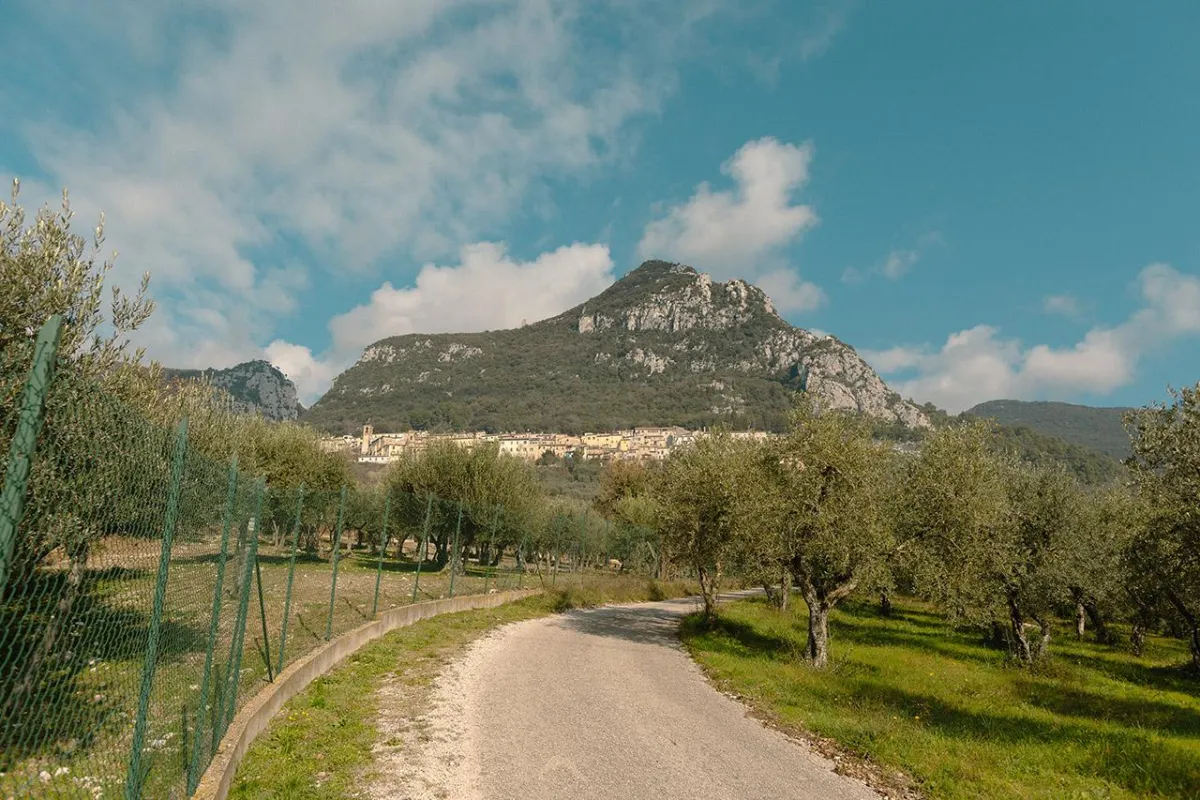
This appellation is linked to the legend of the god of the winds who was thought to live in the bowels of the mountain, from which jets of air, hot in the winter and cool in the summer, issue forth.
For this reason the ancient inhabitants of the area imagined that Aeolus, the god of winds, lived in these places.
Today this phenomenon is easily explained: inside the mountain are numerous caves and tunnels which are identifiable by the currents of air coming out of the earth.
The most famous cave is the one called Eolia, located in the center of the village, with access through the undergrounds of Palazzo Stocchi.
However, throughout the mountain there are significant karst cavities of speleological interest, including the beautiful Gis Cave, near the old quarry on the connecting road between Terni and Cesi.
The Cesi mountain is also extraordinary for hosting, on its summit and other terraces, important archaeological areas with the remains of very ancient places of worship. These sites have been explored through several excavation campaigns and have always exerted a strong fascination on the local populations, giving rise to numerous legends and incredible stories.
In search of Criptona, the underground city
Tunnels, underground roads, hidden cities have inspired the imagination in literature throughout the ages. This is the case, for example, with Moria, the underground city of the dwarves described by J.R.R. Tolkien in The Lord of the Rings, or with the myth of the hollow earth, which inspired Jules Verne’s novel Journey to the Center of the Earth.
Beneath the Martani Mountains, too, there is said to be a hidden, lost city called Crotona — or rather Criptona, from the Greek word meaning, precisely, “hidden.” Ancient legends tell of this place, supported by certain tangible elements, such as the real existence of numerous caves, cavities, and tunnels in the area between Cesi, Torre Maggiore, and Carsulae.
A history enthusiast from Terni, Engineer Costanzi, collected these legends in the 1930s in a small booklet that is now almost impossible to find, beginning with the tale of the Queen of the Umbrians.
Long before the Romans conquered these lands, the Martani Mountains were inhabited by Umbrian peoples, whose stronghold stood at Sant’Erasmo, above Cesi. Yet in a more remote antiquity, lost in the mists of history, the legendary Pelasgian people were also said to have lived there, and it was they who supposedly excavated the caves later used by the Umbrians.
According to ancient accounts, the mountain of Cesi provided access to a true underground kingdom. The tunnels were said to be roads, traveled by the Queen of the Umbrians in her chariot, leading from the mountain all the way to Carsulae.
Fantasy or myth? The fact remains that the mountain of Cesi is still called Mount Aeolus today because air flows from its many internal cavities, beginning with the Eolia Cave located directly beneath the village. There is also a cave entrance at Sant’Erasmo, and another lies just a few meters below the great temple of Torre Maggiore. According to archaeologists, this cave was directly connected to the temple’s cella through a mundus, an opening into which votive offerings were thrown.
The massacre of the Umbrians in the caves of Cesi.
Tito Livio, in Book 10 of his Historiae, speaks about a massacre of two thousand Umbrians, forced by the Romans to find refuge in a cave in which, so the historian claims, the legionnaires found two entrances. So they set fire to the openings of the same causing the warriors to die, suffocated by the smoke and fire. It is thought that the caves were those of Cesi. However, so far investigations carried out by speleologists have been fruitless. It is opportune to remember though that there are numerous caves in the mountain and that, in over two thousand years, there have been collapses and transformations of the same that prevent them from being explored entirely.
The myth of the pagan temple of Torre Maggiore
The Lincei, the Temple, and the Caves
The ruins of the Ara Maior, the great temple first Italic and later Roman, located on the summit of Mount Torre Maggiore at an altitude of 1,120 meters, have long inspired the imagination of local communities. The fame of the temple and of the caves within the mountain endured for centuries, even during the Christian era.
In the seventeenth century, Federico Cesi, founder of the Accademia dei Lincei, described the site as an ancient sacred place devoted to sacrifices, comparable to the great sacred mountains of the ancient world. According to popular tradition, the ruins were believed to be the remains of a tower, and people thought that caves, underground passages, and hidden treasures existed within the mountain. Over time, however, the site also acquired a Christian significance thanks to the Franciscan hermitage of Cesi, associated with Saint Francis and other religious figures.
The Carnival Sabbath
A seventeenth-century tradition recounts an episode linked to the persistence of ancient pagan beliefs on Mount Torre Maggiore. During Carnival, a young girl from Cesi was said to have been led by an old woman to the summit of the mountain, where she witnessed a mysterious nighttime feast filled with music, dancing, and lavish banquets. When she pronounced the names of Jesus and Mary, everything suddenly vanished, and she found herself alone on the mountain.
According to the story, the girl was later found by the friars of the nearby hermitage and returned to her family. She claimed to have seen a great hidden treasure inside the mountain. The tale attracted several Roman nobles who, with papal authorization, attempted to excavate the site in search of the treasure. However, sudden storms and strange events forced them to abandon the undertaking without success, discovering only a few small bronze statuettes.
These stories helped strengthen the mysterious aura of Mount Torre Maggiore, a place where pagan traditions, Christian devotion, and popular legends have intertwined for centuries.
The "Mazzamorelli", the Martani sprites
Another very old story is about the mazzamorello, a goblin who terrorises the inhabitants and travellers with various mischief. In the area it is believed to be active above all at nighttimes, and is responsible for asthma attacks of the unfortunate people and the escape of animals from their enclosures.
The “Mazzamorello Road” runs alongside the Central Umbrian Railway, and was already mentioned in the land registry of Terni as the border between Terni and Narni in 1568.
From the “Vocabulary of Terni dialect” by Flavio Frontini (Terni, 2002) we discover that lu mazzamurellu is a “spirit, goblin – a nocturnal nightmare type of spirit that disturbs sleepers by sitting on their stomach. It is said that during the earthquake of 1917, following the collapse of rock pieces from the ridge of St.Erasmo, many of these creatures were freed into the air”
The mazzamorello is actually present in the folklore of several regions in central-southern Italy. To remain in the area, we can also meet them in some ravines of the Marmore Falls, where they are referred to as gnefro.